
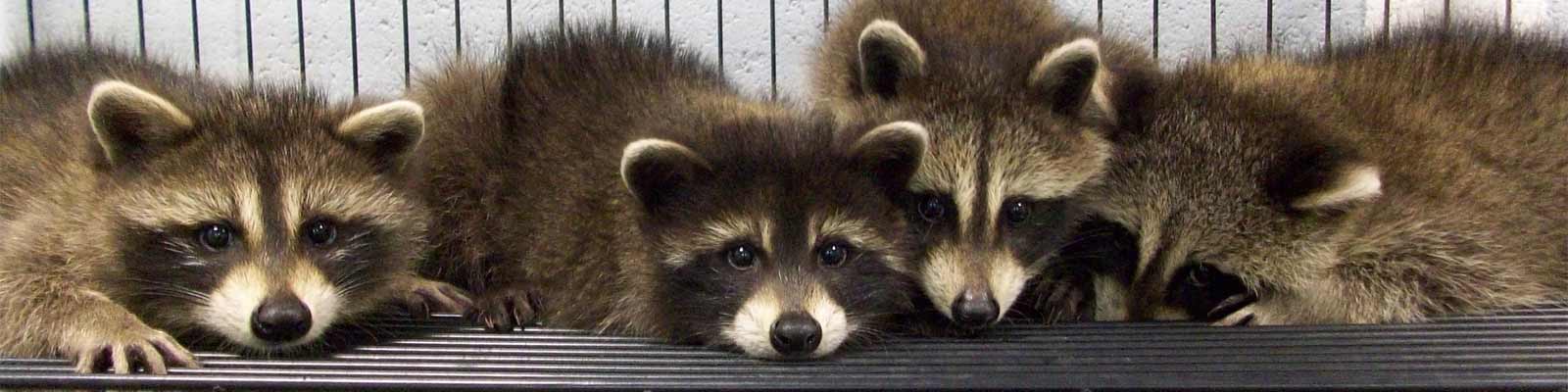
If you accidentally uncovered a den of baby raccoons in your garage, shed, or attic, don’t panic! Raccoons are excellent mothers and will come back for their babies if you give them a chance. Once a den is discovered or disturbed, they will move the babies to a safer location.
If you haven’t moved the babies yet
That’s wonderful — just leave them at their current den site. Next, open any holes or entries you may have sealed up, back off, and give the mother raccoon some time and space to come back for her babies. In most cases, just finding the den is enough to scare the raccoon into finding a better spot. Remember that raccoons are nocturnal, so she may not come back for them or move them until it gets dark.
Raising wild babies in urban and suburban areas is a challenge for urban wildlife – mothers are often forced to move their babies on a regular basis, adding extra stress. Tolerance is encouraged whenever possible. If she and her babies must be moved, check our page on conflicts with raccoons for tips on getting her to move her babies somewhere else. Please note that with any wild family eviction, there’s always a chance a baby or babies could be abandoned.
If you’ve already removed the babies from the den
If you’ve already removed the baby raccoons from the den site, it does not mean that they are automatically orphaned. The mother raccoon will probably still come back for her babies.
To keep the baby raccoons safe while you figure out how to help them, put the raccoons in a small cardboard box with a soft towel or t-shirt. Even on a warm day or indoors, babies can get cold and even hypothermic, so give them a direct heat source.
Heat source options include:
- a clean sock filled with dry, uncooked rice, and microwaved for one minute
- a plastic bottle from the recycling bin filled with hot tap water and wrapped in a tea towel or face cloth
- an electric heating pad set to “LOW” and placed under half of the box.
several chemical hand warmers (e.g. Hot Paws) that stay warm for up to 8 hours
Reuniting the raccoon with their mother
Sometimes baby raccoons can get separated from their mother. If the babies aren’t injured, getting them back to their mom is the best possible option. Raccoons are excellent mothers and will typically come back for their babies if given a chance! Raccoon moms will also take much better care of their babies than any human possibly could.
Place the box with the raccoons (and heat source) as close as possible to the original den site. If you can’t put the babies back where they were found – like into the garage, shed, or attic – put them as close as you can to the entry point the mother was using. Nail or secure the box right next to the entry point if it is on a roof or ledge. If that’s not possible, place the box on the ground directly below the entry point.
Be patient
When a den has been disturbed like this, we know that the mother raccoon is still nearby. She might be too frightened to come back right away, especially if people are still working in the area.
Baby raccoons should be left out for at least one whole overnight period to see if their mother will come back — raccoons are nocturnal, and most likely to come looking for their babies at night. Make sure to KEEP THEM WARM – refresh the direct heat source as needed.
Don’t give the babies anything to eat or drink. Besides causing other potential health problems, we want the babies to be hungry. If they’re hungry, they will cry, and the cries will call their mother.
What if it’s a really busy area?
In high traffic areas, you can put a sign on the box to let other people know that the raccoon is waiting for its mother. Here’s one you can print off. In very busy areas, it may make more sense to bring the baby inside and keep them somewhere dark and quiet for the day. As soon as the sun starts to set and traffic dies down, get them outside right away. No matter what, make sure to leave baby raccoons out for their mother for at least one whole overnight period.
If mom has picked up some of her babies on the first night, reuniting can continue for a second night to give mom the chance to gather the rest of her babies. Remember – she can only take them one at a time and feed herself and her babies as well, so it may take a while for her to move all of them.
What if the baby keeps crawling out of the box?
Older baby raccoons may not stay in the box you put them in. For these babies, cover them with an upside-down laundry basket. Put a brick on top of the laundry basket to keep it in place. The mother raccoon will have no trouble flipping the basket over to get her baby out.
What if it’s raining?
If it’s raining lightly, cover half of the box with a piece of cardboard. If it’s raining hard, bring the babies inside and keep them dark and quiet and warm. Put them back outside as soon as the weather clears up a bit. A mother raccoon won’t be looking for her babies during a heavy rain.
What if it’s during the day?
If you found the baby during the day, put them outside right away – although raccoons are nocturnal, mothers will still look for their babies during the day. They’re good moms. In very busy high-traffic areas, it may make more sense to bring the baby inside and keep them somewhere dark and quiet. As soon as the sun starts to set and traffic dies down, get them outside right away. No matter what, make sure to leave baby raccoons out for their mother for at least one whole overnight period, or two overnight periods if she has started to collect some of her babies.
MYTH! If you touch a baby raccoon, its mother will NOT abandon it. Raccoons are excellent moms. All they want is their baby back.
Mom didn’t come back
If you’ve kept the baby warm and waited at least one whole overnight period (24 hours) and the mother has not retrieved any of her babies, they are probably orphaned. Mother raccoons almost never abandon their babies, but sometimes something happens to mom and she can’t make it back.
Make sure the baby is contained and has a heat source, don’t give it any food or water. The babies should go to a wildlife rehabilitator. Please note that Toronto Wildlife Centre is sometimes at capacity for common baby species, like raccoons, and if you have received a message stating that TWC is full for baby raccoons, you will need to seek assistance from another wildlife rehabilitator – please see the OMNRF list of authorized wildlife rehabilitators and/or the map on our website for more information.
Please click here for next steps and more information if you are unable to find a wildlife rehabilitator to help you.
Temporary care
While you are waiting to hear back from a wildlife rehabilitator, keep the baby raccoon contained in a dark, quiet place. Make sure it has a heat source. Don’t give them any food or water. Further temporary care instructions can be found here.